Norway Rat Removal in Miami, FL
UF/IFAS Extension states that the Norway rat familiar to most people is rare in Florida. That single sentence should shape any Miami quote, because a plan built around a ground-burrowing rat will miss what is actually happening at the roof line.
Start with the finding that matters most. UF/IFAS Extension says plainly that the Norway rat, Rattus norvegicus, the rat familiar to most people, is rare in Florida. The state belongs to the roof rat, which the same publication calls the worst rodent pest in Florida and the most abundant. So the honest answer to "do I have Norway rats" is that almost certainly you do not, and the useful work is telling the two apart before anybody prices a job.
That is worth doing carefully, because the two animals lead to different plans. A Norway rat is a heavy-bodied ground dweller. A roof rat climbs, and it enters buildings at the roof. A crew that arrives with a ground-level burrow playbook will spend its time on a perimeter while the population lives above the ceiling. Every dollar of that visit is spent in the wrong place.
There are still real circumstances in Miami-Dade where a rat found at ground level deserves a second look rather than an assumption. Canal banks and storm drainage, restaurant and commercial service corridors, and disturbed ground on construction sites all produce ground-level rat activity that gets reported as a Norway rat. What that activity turns out to be is a question for the rodent inspection, and the identification is free.
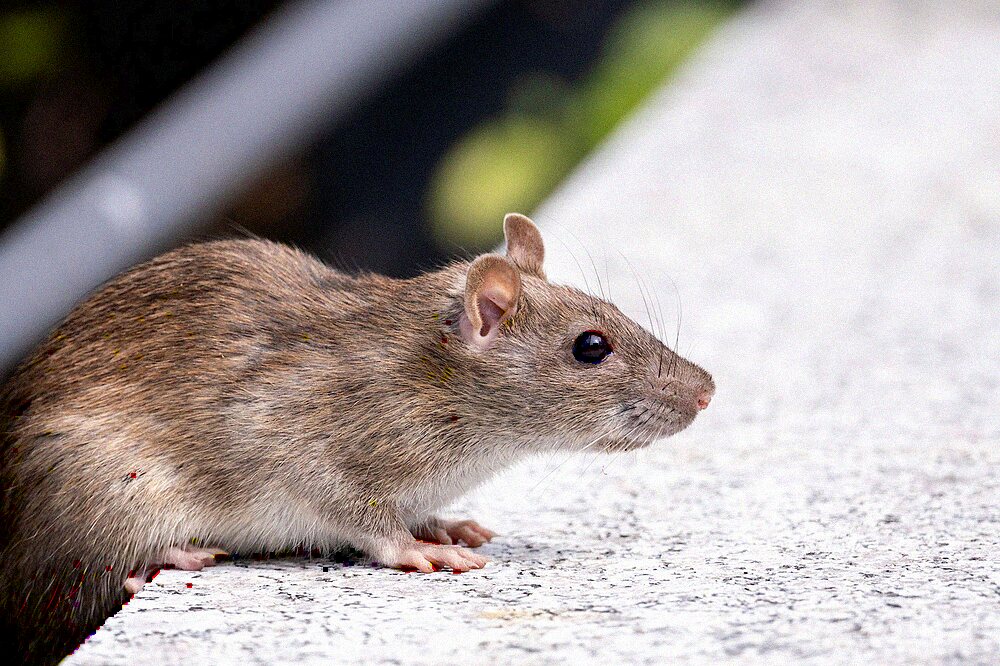
Telling a Norway rat from a roof rat
The tail settles it. UF/IFAS describes the roof rat as 12 to 14 inches long including the tail, 5 to 10 ounces, with a tail longer than the head and body length, hairless, scaly and dark, on a sleek body with prominent ears and eyes. A Norway rat is the blunter animal, heavier through the body, with small ears and a tail that does not exceed the body. If the tail is clearly longer than the rest of the animal, you are looking at a roof rat.
Color will not help you. Florida roof rats come in three color phases, only one of which is black backed, and the others are gray and brownish gray with pale bellies. A large brown rat in a Miami yard is far more likely to be a brown-phase roof rat than a Norway rat, which is the single most common misidentification in this market.
Behavior is the better tell. Activity high in the structure, along wires, through branches or in a palm skirt is roof rat behavior. Activity that stays low, along a wall base, a drain line or a bank, is what makes people reach for the Norway rat name. Even then the sourced Florida statement on burrowing describes roof rats, which UF/IFAS records will nest in burrows in canal banks and under sidewalks or stacks of stored materials. A burrow in Miami is not proof of a Norway rat.
Where a ground-level rat problem does turn up in Miami-Dade
Canal banks and storm drainage are the first setting. The county is threaded with drainage canals and the banks are soft, vegetated and undisturbed, which is the profile that supports burrow nesting for whichever species is present. UF/IFAS specifically records roof rats nesting in burrows in canal banks, so a property backing onto water carries a source of ground-level activity regardless of which rat is involved.
Restaurant and commercial service corridors are the second. Rear service alleys, grease enclosures, dumpster pads and the gaps under roll-up doors concentrate food waste and shelter in a way no residential yard does. Florida restaurant inspections by DBPR are public record, and rodent droppings and rub marks appear routinely in South Florida inspection reports, which is a good reason for any food business to have the exterior walked as carefully as the kitchen.
Disturbed construction ground is the third. Demolition, trenching and stockpiled material displace whatever was living in the ground and push it toward neighboring structures, and stacked materials stored on the ground are named by UF/IFAS as a nesting site. A rat problem that starts the same month the lot next door was cleared usually has its explanation across the fence.
Does it change the job if it turns out to be a roof rat?
It changes where the work happens. A ground-level plan concentrates on the perimeter: door seals, utility penetrations through block, weep points and stored material against the wall. A roof rat plan is a roof line plan, covering the tile eave and its bird stops, the soffit system, vents and deck penetrations, plus cutting the branch and palm routes that give the animal access in the first place.
The sequence is the same either way, and it is the part worth holding a bidder to. Find and record every opening, close the ones with no current traffic, trap what is inside, then close the last runs when activity stops. Sealing a building with animals shut inside produces a dead animal in a cavity, and trapping without sealing produces a standing appointment. The full sequence is set out on the rodent inspection page.
What does change is the price shape. Perimeter sealing on a slab-on-grade house is a different quantity of work from closing a barrel tile eave run and retrofitting vents at height. That is why the sequence should be quoted as separate lines rather than one number, and why the identification belongs at the start of the job rather than in a follow-up visit.
Work Out Which Animal You Have
Four questions from what you can observe without going into the roof. It will not replace an inspection, but it narrows things down, and the answer changes the whole approach.
What can be said about Norway rats, and what cannot
Some things are properly sourced and general to the species rather than to Florida. University extension material gives a Norway rat entry threshold of any opening larger than half an inch, and sets a quarter inch as the standard for rat-proof construction. Extension figures also put reproduction at young born in 21 to 23 days, maturity at around three months, and four to six litters a year, with a female capable of weaning more than 20 offspring in a year.
Other things circulate widely and cannot be traced to a primary source, so this site does not publish them. Norway rat burrow dimensions, quoted everywhere as a depth, a length and an entrance diameter, are not sourced here. Neither are Norway rat dropping sizes. The only sourced dropping figure available is the roof rat one, which UF/IFAS gives as black, banana shaped and about a quarter to half an inch long.
That gap is worth knowing about when you read competing pages. A local page that prints confident Norway rat burrow measurements alongside a claim that the species is common in South Florida has assembled both from general reference material rather than from Florida sources. UF/IFAS is a Florida source with a named author, and what it says about this species here is that it is rare.
Is poison the right answer for a rat outside the building?
It is regulated tightly enough that the answer is rarely simple. UF/IFAS states that all Florida rodenticide labels make it illegal to place poison bait where children, pets, livestock or wildlife can reach it unless the bait is inside a secured tamper-resistant station. Wiring bait blocks into tree branches is illegal in Florida and UF/IFAS records that it has caused thousands of accidental poisonings of dogs and wildlife each year.
The timing works against you as well. The EPA describes anticoagulants as causing death typically four days to two weeks after an animal begins feeding, which means the animal keeps moving for days and dies wherever it happens to be. If any part of its range is inside your structure, that is a possible outcome. UF/IFAS notes that trapping greatly reduces the risk of a poisoned rat dying inside a building and creating an odor problem.
Where exterior stations are used in Florida, humidity dictates the bait form. UF/IFAS advises paraffinized bait blocks or pellets in any outdoor bait station here. It is also worth knowing that the EPA has restricted second-generation anticoagulants to the commercial and structural pest control markets, so the products sold to consumers are ready-to-use stations with block or paste bait, and pelleted consumer bait is no longer permitted.
Who is allowed to do this work in Florida
The wildlife side is straightforward. FWC does not require a nuisance wildlife permit or a gun and light at night permit to take black rats, Norway rats or house mice. They are treated as commensal pests rather than protected wildlife. Bats, raccoons, opossums and listed species are governed differently, and bats carry a maternity season exclusion prohibition, so nothing about the rat position transfers to them.
The pesticide side is where the credentials sit. Rodent work in Florida falls under the FDACS certification category General Household Pest and Rodent Control. A licensed pest control business location must employ a Florida-certified operator in charge for the categories it works in, and must carry bodily injury insurance of 250,000 dollars per person and 500,000 dollars per occurrence. Every provider in this network is expected to hold that standing.
You can check it yourself, and it takes a minute. FDACS runs a public licensing portal where a business license status can be looked up by name. Asking a bidder for the licensed business name and confirming it there is the cheapest verification step available on any rodent quote in this state.
How a Suspected Norway Rat Call Is Handled
The first job is identification, because the plan for a ground dweller and the plan for a climber send the work to different parts of the building.
- 1
Identify the animal
Droppings, rub marks, tail proportion on any animal seen, and the height at which activity is occurring are all recorded. The result decides whether the work runs at the perimeter or at the roof line, and it is settled before anything is priced.
- 2
Walk the ground level and the roof line
Both get surveyed regardless of the initial call, because a ground-level sighting in Miami frequently accompanies roof line entry. Door seals, utility penetrations, weep points and stored material are checked, along with the tile eave, soffits and vents.
- 3
Close the openings with no traffic
Sealing starts where there is no current activity, using mortar, concrete, sheet metal or hardware cloth of 19 gauge or heavier with no opening larger than a quarter inch. Half an inch is enough for a rat to pass, so the quarter inch standard is the one that gets applied.
- 4
Trap, then close the rest
Traps are worked along the confirmed runs until activity stops, and the remaining openings are closed after that. Any exterior bait station used is a secured tamper-resistant unit with paraffinized blocks, which is what Florida labels and Florida humidity both require.
What This Page Will Not Do
It will not sell you the wrong species
UF/IFAS Extension states that the Norway rat familiar to most people is rare in Florida, and that roof rats are the worst rodent pest in the state and the most abundant. A Miami rodent plan built around a burrowing ground rat sends a crew to the perimeter while the population lives above the ceiling. Identification comes first here because it decides where every hour of the job gets spent.
It will not publish figures nobody can source
Norway rat burrow dimensions and dropping sizes appear on competitor pages as confident numbers. Neither could be traced to a primary source, so neither appears here. The one sourced dropping figure in Florida is the roof rat one from UF/IFAS: black, banana shaped, about a quarter to half an inch long, with dark rub marks along travel routes.
It will not treat a burrow as proof
The sourced Florida statement about rats nesting in burrows is about roof rats. UF/IFAS records that roof rats will nest in burrows in canal banks and under sidewalks or stacks of materials stored on the ground. A burrow behind a Miami property backing onto a canal is entirely consistent with the species that also gets into the attic.
Settle the Identification First
The inspection records droppings, rub marks and the height at which activity is happening, and it names the species before anything gets priced. There is no charge for it.
What a Ground-Level Rat Job Costs
No aggregator publishes Miami rodent cost data, so these bands come from the nearest Florida market and from national guides, labeled accordingly. Tampa is the only Florida metro with a published rat exterminator cost page, and it puts a visit at around 1,078 dollars on average within a typical range of 441 to 1,716 dollars, with exclusion sealing at 550 to 1,642 dollars. National guides put a standalone inspection at 75 to 150 dollars.
| Service | Typical range | What moves the number |
|---|---|---|
| Species identification and inspection | Free with service | Priced alone nationally at $75 to $200 and usually credited against the job |
| Trapping and removal | $440 to $1,720 | Nearest Florida market figures (Tampa); driven by property size and how long activity has run |
| Perimeter exclusion sealing | $550 to $1,650 | Wall length, number of utility penetrations, door seal condition and stored material |
| Exterior bait stations | Quoted per station | Tamper-resistant stations with paraffinized blocks, as Florida labels and humidity require |
| Attic cleanup and decontamination | $600 to $1,000 | Applies where the identification turns out to be roof rats after all |
These are typical ranges across Miami-Dade and south Broward. Every property is different, and the free inspection produces the actual figure with each part of the job priced as its own line item.
What Reddit Says About Norway Rat Removal in Miami
Species confusion is a live theme in homeowner threads, including one case where two different companies disagreed with each other over what an animal was. The practical advice that comes out of it is to photograph the animal or the droppings before anything is cleaned up, and to ask a bidder to name the species and say what the identification is based on. A quote that never names an animal is a quote that has not looked.
On vetting, the pattern is the same as for any rodent work. Multiple bids for identical scope, itemized so trapping, sealing, cleanup and any ongoing plan are separate lines, and a direct question about whether the company performs the repair work itself. The warnings run toward poison-only plans with no sealing, monitoring contracts bundled into a removal price, and sealing carried out while animals are still inside. Real quotes people compare in these threads vary so widely for similar descriptions that the recurring question is whether they are being taken advantage of.
The questions worth carrying into a Miami bid are the ones the corpus keeps repeating: what is included and what is a separate line, will you decontaminate or only trap, how many follow-up visits are in the price, and what happens if they come back. On a suspected Norway rat call here, ask one more before any of those. Which species is this, and what in the survey says so.
A Common Ground-Level Call
A common call from a property backing onto a drainage canal
The situation. A large rat seen twice at dusk near the rear fence line, a burrow entrance in the bank, and droppings along the base of the garage wall. The household assumes Norway rats because the animal looked heavy and stayed on the ground.
What gets done. The survey records tail proportion from a photo, dropping shape and the rub marks, and finds activity running up the corner of the garage to a soffit gap. The identification comes back roof rat. Perimeter openings and the soffit gap are recorded, sealing begins away from the active corner, and traps are set along the marked run.
How it turns out. The bank stays a source, because the canal is not going anywhere, and the building stops being an option. Stored material along the garage wall is moved off the ground, and the household stops finding droppings inside the garage within the month.
Norway Rat Questions
Are there Norway rats in Miami at all?
They exist in Florida, and UF/IFAS Extension describes the species as rare in the state. That is a Florida-specific statement from a named extension specialist, which is a stronger basis than the general reference material most pages rely on. The practical consequence is that a Miami sighting reported as a Norway rat is far more likely to be a roof rat in one of its lighter color phases, and the tail proportion is the check that settles it. A roof rat tail is longer than its head and body together.
Why do people keep saying the rat they saw was too big to be a roof rat?
Because size expectations come from pictures of Norway rats. UF/IFAS gives an adult roof rat as 12 to 14 inches including the tail and 5 to 10 ounces, which is a substantial animal, and a large brown-phase individual at dusk reads as enormous. The proportions are what to look at instead of the impression: prominent ears and eyes, a sleek build, and a long hairless scaly tail that exceeds the body length.
Do I really need the chewed openings repaired now, or can I get away with trapping?
Trapping alone clears what is currently inside and leaves the building open, which is the single most criticized approach in homeowner discussion of this trade. The openings are what decide whether the problem returns, and the relevant measurements are public: half an inch is enough for a rat to pass and a quarter inch is the standard for rat-proof construction. Sealing can be sequenced so it does not trap animals inside, which is why the openings without current traffic get closed first.
Does a burrow in the yard mean the rats are not in the attic?
No, and in South Florida it may mean the opposite. UF/IFAS records that roof rats, which are otherwise above-ground nesters, will nest in burrows in canal banks and under sidewalks or stacks of stored material. So a burrow is consistent with the same species that uses your soffit. The survey checks both levels for this reason, and a bid that only walks the ground because a burrow was reported has stopped halfway.
Is a restaurant rat problem handled differently from a house?
The sequence is the same and the setting adds constraints. Service corridors, grease enclosures, dumpster pads and roll-up door gaps concentrate food and shelter, and Florida restaurant inspections by DBPR are public record, with rodent droppings and rub marks appearing routinely in South Florida reports. That makes documentation part of the deliverable, so the work should produce a written record of what was found and what was closed rather than only a completed visit.
Related Services
Mouse Removal
A quarter of an inch is enough for a mouse to get through. Finding and closing the openings that size.
Read more →Squirrel Removal
Daytime attic noise, chewed gable vents and the damage squirrels leave behind.
Read more →Rodent Inspection
A full roofline, attic and foundation inspection that tells you what is actually happening.
Read more →More about how this works on the about page, or get in touch to book a free inspection.
Get the Species Identified
The inspection names the animal, records where activity is happening, and produces a written list of openings before anything is priced. The phone is answered 24 hours a day.